.png)
REVIEW: Where the Grand Tour Meets Modern Rome
Updated: Aug 10
Hotel de la Ville offers a compelling base for experiencing Rome slowly, moving between storied streets and hidden gardens

Rome does not reveal itself all at once. Even after days spent walking its streets, there is always another courtyard behind an unassuming doorway, another fresco overhead, another church containing a masterpiece that elsewhere might command a museum of its own. Layers of antiquity, Renaissance ambition, Baroque drama, fashion, cinema and contemporary culture sit almost impossibly close together. The Colosseum belongs to the same city as Valentino. Caravaggio and Bernini share the cultural landscape with Gagosian and MAXXI. A morning can begin among Roman ruins, move through the boutiques of Via Condotti and end over dinner above a skyline punctuated by domes that have watched centuries pass beneath them. It is this collision of eras that makes Rome endlessly compelling, and it is also what Hotel de la Ville understands particularly well.
Our stay began at one of the most enviable addresses in the city. Hotel de la Ville sits on Via Sistina, immediately above Piazza di Spagna and the Spanish Steps, placing much of central Rome within remarkably easy reach. Step outside and the city is already happening around you. Via Condotti and its fashion houses lie below, Villa Borghese is close enough for an unplanned morning walk, and some of Rome's most recognisable monuments can be reached without thinking about transport at all. The pleasure of staying here is not simply having a prestigious address, but being able to surrender to Rome's greatest habit: wandering.
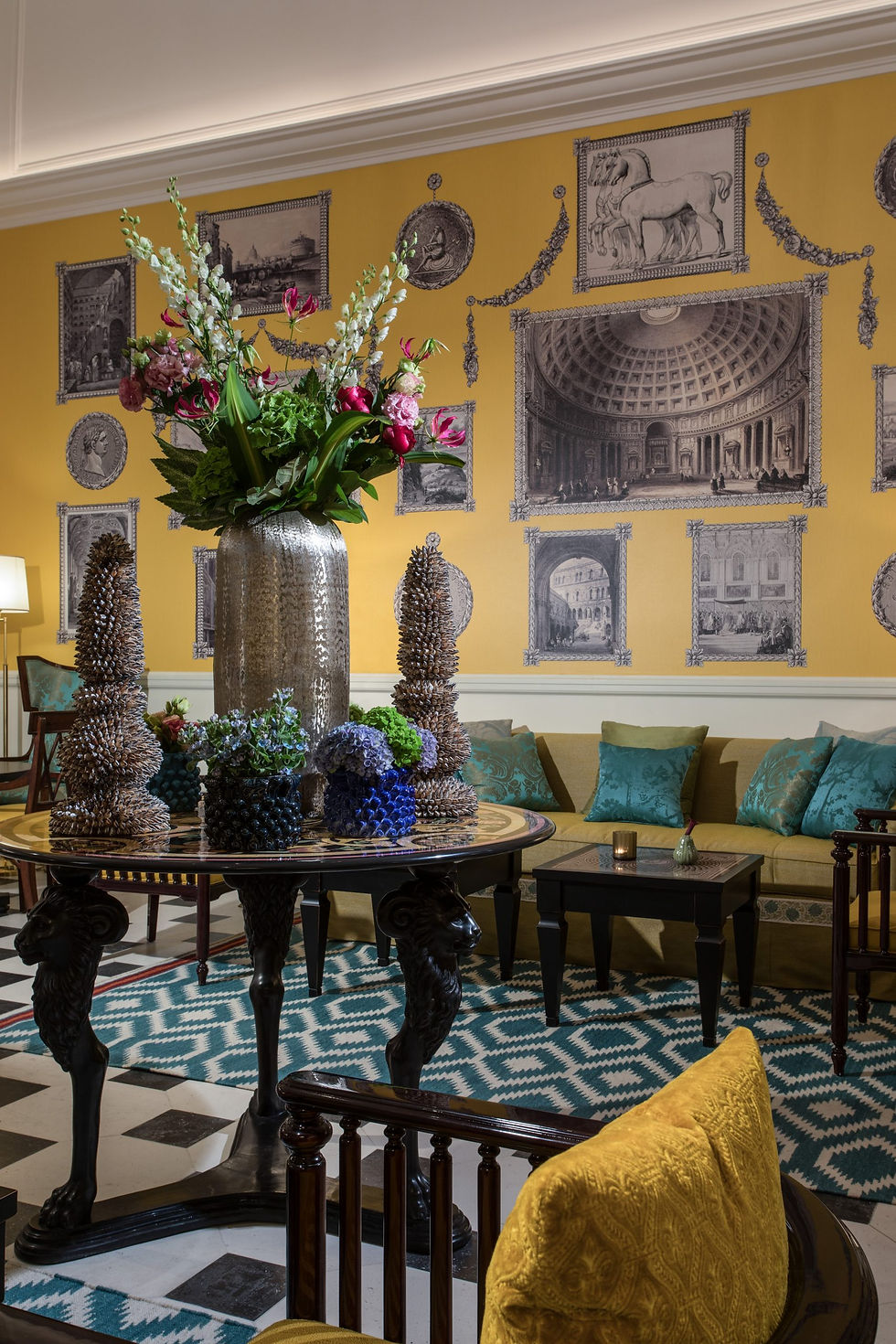
There is an appealing contrast when the doors close behind you. Outside, Rome is animated, crowded and gloriously unpredictable. Inside, the tempo changes. Hotel de la Ville feels less like a conventional city hotel than an elaborate Roman residence assembled over time. Its historical roots reach into the eighteenth century and the era of the Grand Tour, when young European aristocrats travelled south in search of classical antiquity, art, architecture and cultural education. Rome became one of the essential destinations of that journey, and the building that would eventually become Hotel de la Ville welcomed travellers during this period. When Rocco Forte Hotels reopened the property in 2019 following a substantial restoration, designers Tommaso Ziffer and Olga Polizzi used that history as the starting point rather than treating it as something to recreate literally.
That approach gives the interiors their character. There are antique references and contemporary gestures, richly patterned fabrics beside modern furniture, artworks alongside vintage objects and decorative pieces that suggest generations of collecting. Handmade wallpapers and Italian textiles add visual richness, yet the rooms do not feel staged as historical reproductions. The Grand Tour becomes an atmosphere rather than a theme. Moving through the hotel, we found ourselves repeatedly stopping to notice small details, from an unexpected tapestry to a shift in colour or an object positioned as though someone had brought it home from a journey years ago. The property rewards looking closely, much as Rome itself does.
The hotel now has 104 rooms and suites across several categories, with the current accommodation collection ranging from elegant rooms overlooking Via Sistina or the internal courtyard to expansive Forte Suites with terraces over the city. Official 2026 information confirms 55 bedrooms, 34 junior suites and 15 suites. Throughout, the aesthetic maintains the same conversation between classical Rome and contemporary Italian design. Marble bathrooms bring a substantial sense of luxury, while textiles, artworks and carefully chosen objects prevent the spaces from slipping into the anonymity that can affect even excellent city hotels.

What lingers most is the sense of inhabiting Rome rather than simply sleeping in it. In the suites, terraces open the hotel outward, framing terracotta roofs, church domes and the uneven skyline that gives the city so much visual character. The Roma Suite is conceived as an elegant city apartment, while the Canova Suite carries the name of the celebrated Neoclassical sculptor. At the upper end of the property, the experience becomes increasingly residential, with spaces suitable for entertaining and prolonged stays rather than merely returning to bed after sightseeing. It is easy to understand why this matters after several days in Rome. The city asks much of the senses, and having a generous private space to return to becomes part of the pleasure.
The internal courtyard produces an entirely different mood. Rome is a city where outdoor space carries enormous value, particularly during long summer days, and Hotel de la Ville's garden feels unexpectedly secluded given everything happening beyond its walls. Garden designer George Carter drew upon formal seventeenth century geometry and references to the Grand Tour, incorporating obelisks, layered planting and architectural details into a space connecting the historic buildings around it. In the morning, it becomes one of the loveliest places in the hotel to begin the day, when the heat has not yet settled over Rome and breakfast can unfold outside without urgency.

Mosaico is the hotel's breakfast setting, and the experience is generous without feeling excessive. Freshly baked breads and pastries sit alongside seasonal produce, cheeses, cold cuts and a broader à la carte selection. There are distinctly Roman touches, including Carbonara scrambled eggs, which sound playful on paper but make perfect sense within a hotel that constantly brings the city into the experience. Fulvio Pierangelini, Creative Director of Food for Rocco Forte Hotels, oversees the property's culinary direction, giving its different venues a coherent Italian sensibility while allowing each to retain a separate identity.
Café Ginori may be the clearest expression of how contemporary hospitality is moving beyond traditional divisions between hotel, restaurant and design. Created with historic Florentine porcelain house Ginori 1735, it surrounds guests with patterns and decorative codes drawn from collections including Oriente Italiano, Il Viaggio di Nettuno and Labirinto. The collaboration extends beyond the tableware into upholstery, wallpaper and furnishings, making the café feel like an inhabited design world rather than a restaurant decorated with branded porcelain. The official hotel site continues to position Café Ginori as an all day dining destination where food, design and retail intersect. For anyone interested in Italian fashion, interiors or craftsmanship, it becomes as much a visual experience as a culinary one.
Elsewhere, Julep takes its inspiration from historic spice routes and focuses on herbs, vermouths and infusions, while the upper levels of the hotel belong to Cielo. This is where the relationship between the property and Rome becomes most cinematic. By late afternoon, the city begins changing colour. Stone facades warm under the lowering sun, shadows stretch across rooftops and the domes scattered through the historic centre become increasingly pronounced against the sky. From Cielo, the panorama opens almost completely, with Rome spreading outward in a textured landscape of terracotta, cupolas and bell towers.

It is tempting to fill every hour in Rome. There is always one more museum, another church, another restaurant reservation or neighbourhood to explore, yet Cielo makes an excellent argument for occasionally doing nothing more complicated than sitting down and looking. Drinks arrive while the skyline moves gradually from gold to amber and then into the deeper tones of evening. Small dishes make lingering easy, and the rooftop becomes less an amenity than a vantage point from which to absorb the city as a whole. The hotel describes Cielo Bar as offering panoramic views over Rome's historic skyline, but the experience is more atmospheric than that description suggests. From above, the extraordinary density of Rome becomes visible. History does not appear as a collection of monuments here. It becomes the cityscape itself.
After days spent walking on cobbles, climbing staircases and moving continuously through Rome, the Irene Forte Spa becomes increasingly persuasive. Hidden below street level, it creates a dramatic change in sensory register. The palette darkens, sound softens and the energy of the streets feels suddenly distant. The spa draws heavily upon Sicily, both through its aesthetic and Irene Forte Skincare, whose formulas incorporate botanicals associated with the island. The current spa facilities include five treatment rooms, a hydropool, plunge pool, Kneipp footbaths, an ice element, salt inhalation room, steam room, sauna and relaxation areas, alongside a 24 hour gym.
The contrast is what makes the wellness experience particularly successful. A resort spa often works in collaboration with an already relaxed environment. Here, restoration follows sensory saturation. Rome fills the day with traffic, voices, heat, architecture, artworks and movement, while the spa removes almost all of it. Treatments and thermal rituals become a way of resetting before returning to the city again. This connection between place and wellness prevents the experience from feeling generic. Sicily enters through botanicals and Mediterranean references, while Rome remains just beyond the doors.

Hotel de la Ville also succeeds because it does not ask guests to experience Rome only through conventional sightseeing. The property can arrange deeper encounters with the destination, including access connected to Cinecittà Studios, exploration of Roman architecture and contemporary art, private cultural itineraries and experiences focused on viewpoints normally unavailable to visitors. Its Above and Beyond programme for guests of the Panoramic Penthouse, for example, is built around Rome's rooftops, domes and less accessible perspectives. The premise fits the property particularly well because the hotel is most convincing when acting as an interpreter of Rome rather than a refuge from it.
This is also what distinguishes the best urban hotels from those that could be transported almost intact from one global capital to another. Service can travel. Marble can travel. Excellent beds, sophisticated restaurants and beautiful spas can all be replicated. A genuine sense of place is more difficult. At Hotel de la Ville, Rome appears in the architecture, the Grand Tour references, the Ginori porcelain, the food, the rooftop perspective and even the transition between the intensity of the street and the privacy of the courtyard.
There are practical strengths too. For first time visitors, the location eliminates much of the friction that can accompany navigating a large historical city. For returning travellers, it provides immediate access to neighbourhoods and places that reward revisiting. The hotel is moments from Spagna metro station, approximately 15 minutes by car from Termini station, and the property lists typical transfers of around 30 minutes from Ciampino and about 45 to 50 minutes from Fiumicino depending on traffic and routing. Once checked in, however, the most rewarding form of transport remains walking.

By the end of our stay, the most memorable aspect was not a particular suite detail, dish or treatment, although there were many worth remembering. It was the continuity between hotel and city. Breakfast led naturally into a walk through Rome. An afternoon exploring galleries made the descent into the spa more satisfying. Dinner and drinks on the rooftop returned our attention to the skyline we had spent the day moving beneath. Even the hotel's decorative language began to make greater sense after encountering Rome's own layering of periods, objects and artistic traditions.
Rome has spent centuries absorbing influences without losing itself, and Hotel de la Ville achieves something similar on a smaller scale. The property carries the romance of the Grand Tour without becoming nostalgic, celebrates Italian craftsmanship without turning it into display and delivers contemporary luxury without severing its relationship with the city outside. For Atlas, that is ultimately what makes the stay worth recommending. Hotel de la Ville does not provide a polished bubble from which to observe Rome at a distance. It draws the city inward and then sends you back out into it, repeatedly reminding you that in the Eternal City, the richest experience is found somewhere between where you stay and everything waiting just beyond the door.


Comments