.png)
Chasing the Cooler Side of Europe
Austria’s mountains and lakes meet Germany’s creative cities in a summer escape made for long days outdoors and spontaneous discovery

There is another version of the European summer waiting beyond the familiar procession of Mediterranean beaches and crowded historic centres. It begins somewhere on a train, perhaps with a window framing mountains that seem to grow larger with every kilometre, or on a city street where the morning plan extends no further than coffee, a market and whatever happens afterwards. There are lakes cold enough to make the first step into the water feel momentarily ambitious, roads curling towards snow-dusted Alpine peaks, neighbourhood restaurants discovered without a reservation and long evenings that invite travellers to remain outside until the last of the light disappears.
Across Austria and Germany, summer lends itself particularly well to this kind of travel. The two countries offer distinctly different experiences, yet together they make a compelling case for a journey built less around ticking off landmarks and more around moving between cities, neighbourhoods and nature at a pace dictated by curiosity.
For travellers arriving from the GCC, there is another obvious attraction. When temperatures at home are at their most intense, Austria's mountains and lakes offer the promise of cooler air, while Germany makes it remarkably easy to move between energetic cities and green spaces without having to choose one kind of holiday over another. Both countries are supported by extensive transport networks, allowing the journey itself to become part of the experience rather than something endured between destinations.Austria makes perhaps the most cinematic introduction. Board a train in one of its cities and the landscape can change dramatically beyond the glass. Buildings begin to thin, green becomes increasingly dominant and eventually the Alps rise into view. ÖBB Austrian Federal Railways connects major cities with Alpine and lakeside regions, with Railjet services making it possible to construct a multi-stop summer journey without relying heavily on domestic flights or long drives. There is something wonderfully old-fashioned about crossing a country by rail, yet Austria's contemporary network makes the experience feel entirely practical. Settle into a seat, watch the landscape unfold and allow the transition between places to become visible.

For those who prefer to take control of the journey, the perspective changes again on the Grossglockner High Alpine Road. The celebrated mountain route climbs through the Austrian Alps to elevations above 2,500 metres, winding through an increasingly dramatic landscape of valleys, glaciers and towering peaks. Austria's highest mountain, the Grossglockner, dominates the surrounding scenery, but the appeal lies as much in the road as in the eventual viewpoints. Corners reveal new expanses of mountain and sky, encouraging the kind of repeated stopping that turns what might have been a transfer into an entire day.
Eventually, the mountains give way to water. Carinthia, in Austria's south, introduces an unexpectedly languid quality to the Alpine summer. The region combines mountain scenery with a milder, almost Mediterranean atmosphere, and Lake Wörthersee sits at the centre of its warm-weather identity. Turquoise water meets elegant promenades and green hills, producing the sort of landscape that immediately changes the pace of a trip. Here, summer becomes less about getting somewhere and more about staying where you are.

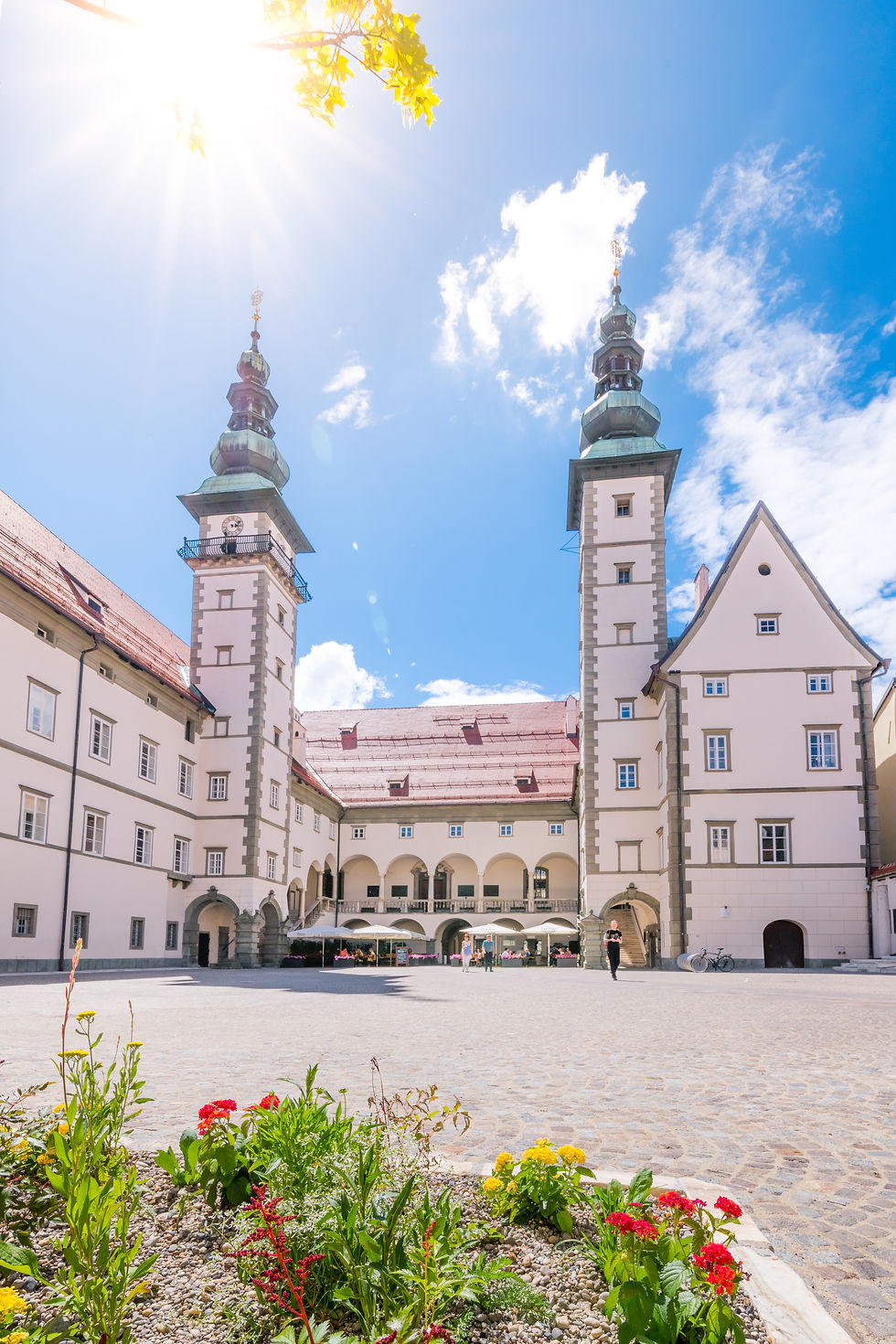
Klagenfurt am Wörthersee provides a natural base for exploring this part of Austria. Days can stretch between the lake and the surrounding countryside, with boat cruises offering an unhurried way to experience Wörthersee from the water. The Pyramidenkogel observation tower changes the perspective completely, opening panoramic views across the surrounding landscape, while Minimundus offers something more playful through miniature recreations of famous landmarks from around the world.
Food naturally becomes part of the rhythm. Restaurant Maria Loretto pairs lakeside dining with views across Wörthersee, while evenings can finish above Klagenfurt at Rooftop Bar 19null7, where the city, mountains and changing summer sky meet in the distance. There is no need to manufacture a complicated itinerary. A boat, a swim, a long lunch and somewhere beautiful to watch the light disappear can be enough.
Cross into Germany and the summer story changes texture. Nature remains remarkably accessible, but the energy increasingly comes from the cities themselves and, more specifically, from their neighbourhoods. Germany rewards travellers willing to move beyond the monumental version of urban sightseeing and into the districts where people actually shop, eat, meet friends and spend their weekends.

This is where the idea of the “friendcation” becomes particularly relevant. Travelling with friends rarely follows the same rhythm as travelling alone, as a couple or with children. The best days often resist strict schedules. Someone wants to browse vintage stores. Someone else wants lunch. A gallery appears unexpectedly. Drinks become dinner. A planned afternoon at a museum is abandoned because the weather is too beautiful to stay indoors.
Germany accommodates this kind of collective indecision unusually well. In Berlin, Kreuzberg and Friedrichshain offer the sort of urban texture that encourages wandering. Independent galleries and street art sit alongside parks, markets and a food culture shaped by the city's international communities. Markthalle Neun has become one of Berlin's best-known destinations for food, while Viktoriapark, Volkspark Friedrichshain and Park am Gleisdreieck provide somewhere to slow the day down again. A morning can begin among stalls and cafés before drifting towards a park with very little concern for conventional sightseeing.
Berlin has always been at its most interesting when allowed to remain slightly unstructured. The city is too sprawling and too culturally fragmented to reveal itself through a checklist of monuments alone. Its personality emerges between them, in courtyards, neighbourhood bars, repurposed industrial spaces and the stretches of street where murals and independent businesses reveal how dramatically one district can differ from the next.

Hamburg offers its own variation. Sternschanze and Karoviertel bring together independent boutiques, local designers, concept stores, vintage finds and cafés, while nearby Schanzenpark and Planten un Blomen allow the city to breathe. Water is never far from Hamburg's identity either. The Alster and its surrounding routes create opportunities to walk through parks and residential neighbourhoods while remaining firmly within the city, blurring the boundary between an urban afternoon and an outdoor one.
That ability to shift mood without necessarily changing destination repeats itself across Germany. Munich's Glockenbachviertel and Gärtnerplatz combine colourful squares with independent shops and cafés. Düsseldorf's Flingern district introduces galleries, murals, design stores and an eclectic dining scene. Cologne's Ehrenfeld layers multicultural influences over industrial heritage and contemporary creativity. None needs to be treated as a conventional attraction. Their appeal lies in experiencing the city at neighbourhood scale.
Then there are the markets. Travelling with friends makes eating particularly democratic. Instead of agreeing on a restaurant three times a day, everyone can wander, taste and share. Germany's weekly farmers' markets, indoor market halls, flea markets and food festivals turn that freedom into part of the destination. Traditional regional dishes sit alongside international food, while vintage fashion, handcrafted pieces and locally made goods make markets equally compelling for those more interested in browsing than eating.
These are the moments that often become disproportionately memorable. Not necessarily the dinner booked weeks before travelling, but the thing ordered because someone at the next table was eating it. A piece of vintage clothing discovered in Cologne. Something unfamiliar tasted at a Berlin market. Coffee that quietly turns into two hours because nobody feels any particular urgency to leave.
The great advantage of a German summer is that this urban life does not require sacrificing nature. Cities can become departure points rather than boundaries. Berlin's Green Routes and Berlin Wall Trail make walking a way of understanding the city geographically and historically. Hamburg's Alster routes follow waterways through greener districts, while in the Rhine-Main region, walking routes connect Frankfurt's unmistakably urban skyline with countryside and neighbouring communities.
Further afield, the possibilities broaden into forests, rivers and lakes. A morning spent at a market can become an afternoon cycling beside water, canoeing, walking through woodland or simply finding somewhere to swim. In North Rhine-Westphalia, even former industrial landscapes have acquired another life as recreational spaces, with walking and cycling routes moving through places where the country's industrial past and contemporary reinvention visibly overlap.
Austria and Germany therefore arrive at a similar summer proposition from different directions. Austria seduces first through landscape. Germany often does so through urban life. One might begin with a Railjet moving towards the Alps, a mountain road climbing towards the Grossglockner or the brilliant water of Wörthersee. The other might begin at a table in Berlin, inside a Hamburg concept store or on a bicycle path leading unexpectedly away from the city.
Yet both reward the same style of traveller: someone prepared to leave room in the itinerary.
That feels increasingly valuable. Travel has become extraordinarily easy to research and, paradoxically, extraordinarily easy to overplan. Restaurants are bookmarked months ahead. Every photogenic viewpoint has already been located on a map. Social media tells travellers where to stand before they have even booked the flight. A journey can arrive so thoroughly organised that very little discovery remains once it begins.
Central Europe offers an appealing antidote precisely because moving around is relatively straightforward. Efficient transport does not simply make a holiday easier. It creates freedom. When the logistics require less thought, travellers can decide that morning whether they want mountains or museums, a market or a lake, another neighbourhood or an afternoon doing very little at all.
For GCC travellers in particular, this flexibility combines with one of the simplest pleasures of travelling north during summer: being outdoors again. Fresh mountain air, green parks, water, forests and long evenings take on a different value after months shaped by intense heat. Austria Tourism specifically identifies cooler temperatures, Alpine landscapes and lakeside experiences among the country's summer draws for visitors from the region, while Germany's tourism offering similarly emphasises the ease with which city experiences can be paired with outdoor adventures.There is also something inherently social about this version of Europe. A train compartment encourages conversation in a way an airport rarely does. Markets are made for sharing. Lakes invite entire afternoons rather than timed visits. A road trip through the Alps creates its own stories long before the final destination appears. Neighbourhood travel allows people to separate and reconvene without the pressure to experience every moment identically.
Perhaps this is what makes the combination of Austria and Germany particularly interesting for a contemporary summer journey. Neither requires travellers to choose between city and countryside, activity and relaxation, food and culture, or the pleasures of movement and those of staying completely still.
The days can contain all of them. There might be coffee on a Berlin pavement one morning and a walk beside the Alster several days later. Another part of the journey could unfold beside Wörthersee, where mountains rise beyond turquoise water and lunch has no reason to end quickly. Somewhere in between comes the view through a train window, the bend in a mountain road, the vintage piece nobody expected to find or the decision to jump into a lake because the sun has finally appeared.
The European summer has always been romanticised through destinations. Austria and Germany make a persuasive argument for romanticising the journey instead. Not simply where you arrive, but how you move, who you travel with, what you discover accidentally and the landscapes, meals and conversations that fill the distance in between.


Comments